

Views: 0 Author: Site Editor Publish Time: 2025-11-15 Origin: Site
In an era of increasing climate disruptions and grid instability, businesses face unprecedented challenges in maintaining reliable power supply. From agricultural processors risking millions in spoiled inventory during blackouts to remote industrial operations seeking energy autonomy, the quest for energy independence is becoming a strategic imperative across the commercial and industrial (C&I) sector.
Recent years have witnessed a dramatic shift in how businesses approach energy security. Climate-driven disasters now account for approximately 80% of major power outages, costing American businesses an estimated $150 billion annually. These aren't merely inconveniences but existential threats—imagine a cold storage facility losing power during harvest season, potentially spoiling millions of dollars of agricultural products.
The traditional grid, designed for a different era, struggles with aging infrastructure compounded by extreme weather events. In California, preventive shutoffs to reduce wildfire risk have joined Texas' weather-induced outages as recurring challenges. For C&I facilities, these events transform from rare occurrences to operational realities that demand new solutions.
Simultaneously, the economic case for energy independence has strengthened. Solar power costs have plummeted over the past decade, while battery storage technology has become increasingly affordable and scalable. Government policies, such as investment tax credits and building codes requiring solar-plus-storage on new commercial buildings, further accelerate adoption.
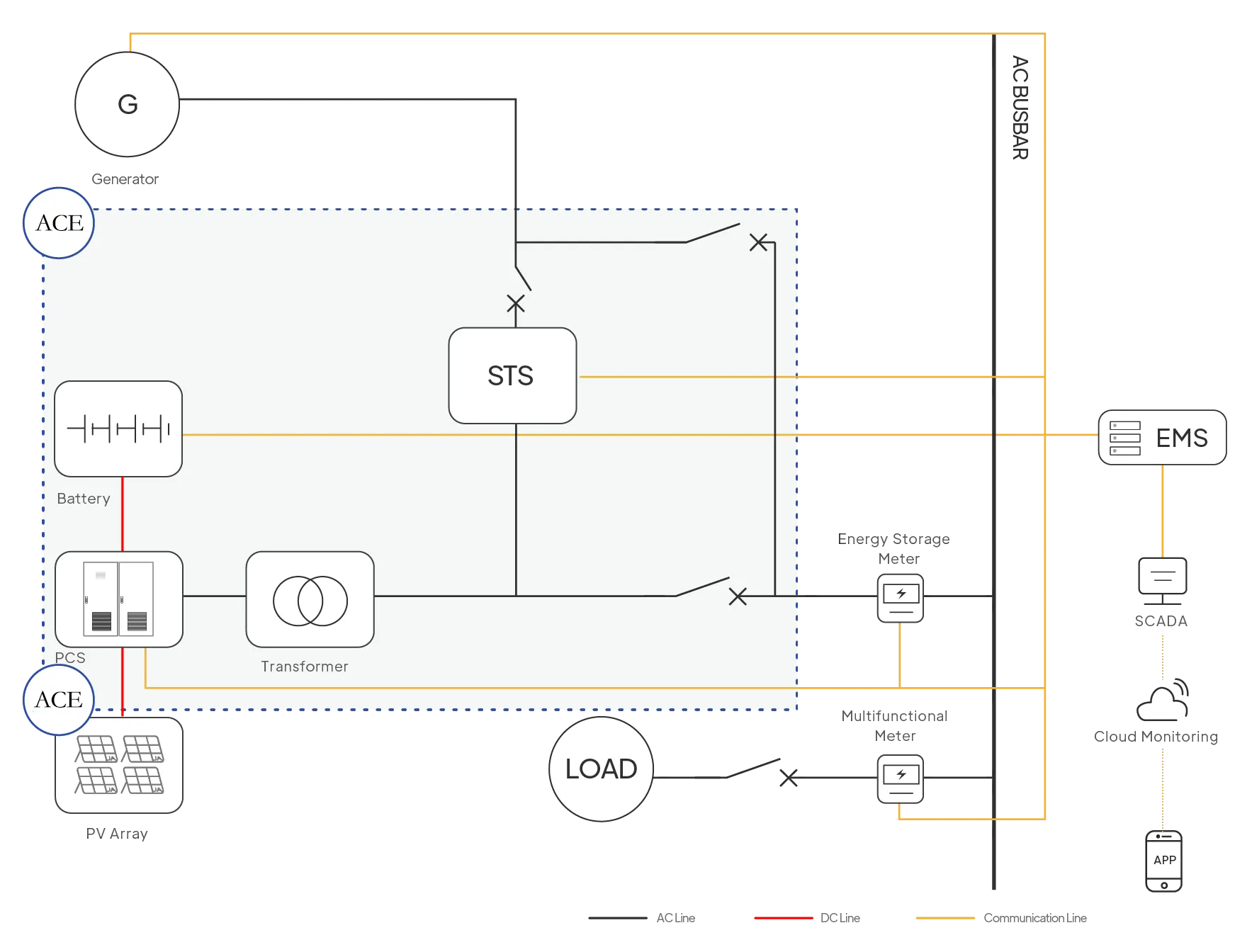
An effective off-grid C&I microgrid relies on sophisticated integration of multiple energy sources and control systems. The typical architecture includes:
Multi-source renewable integration: Solar PV, wind turbines, and sometimes small hydro or generators work in concert
Energy storage systems: Primarily lithium-ion batteries for their high energy density and declining costs
Advanced power conversion systems: Supporting multiple control modes and seamless transitions between operating states
Intelligent controls: Layered control systems that can manage economic optimization and resilience requirements
The most advanced systems employ a DC-coupled design that integrates PV, storage, and generator assets with minimal energy conversion losses. This architecture enables rapid switching between energy sources—often in less than 20 milliseconds—ensuring continuous power quality even during source transitions.
Modern microgrids utilize a modular control architecture that can scale with project complexity. This typically includes three layers:
Energy Management System (EMS) - Focused on economic optimization through peak shaving, PV self-consumption, and demand response programs
Microgrid Controller (MGC) - Adds resiliency capabilities including grid loss detection, automatic transfer, and load shedding during faults
Switchgear & Interconnection - Provides advanced power distribution and interconnect logic for complex, multi-source projects
This layered approach allows facilities to start with basic cost-saving functionality and add resilience features as needed, matching investment to operational requirements.
While reliability drives initial interest, the economic case for off-grid microgrids has become compelling. Compared to traditional diesel generation—where most expenditure goes to regular fuel purchases—solar PV and storage solutions require higher initial investment but significantly lower operating costs. This creates a favorable long-term cost structure that can be further optimized through:
Reduced demand charges through peak shaving
Energy arbitrage opportunities by storing low-cost energy for high-value use
Avoided outage costs that might otherwise disrupt operations and revenue
Case studies demonstrate impressive results, with some implementations achieving 32% financial savings alongside 90% emission reductions compared to traditional generator-based systems.
For many C&I operations, energy resilience has transitioned from a specialized concern to a core business requirement. The ability to operate independently during grid disturbances provides:
Continuous operations for temperature-sensitive processes (cold storage, manufacturing)
Production stability for just-in-time manufacturing and processing
Equipment protection from grid fluctuations and brownouts
Most C&I companies lack renewable energy development as a core competency, leading many to externalize financing through specialized partners. Common approaches include:
Third-party ownership models where developers finance, build, and operate the system
Power purchase agreements (PPAs) that convert capital expenditure into operational expenditure
Energy-as-a-Service arrangements that bundle technology, maintenance, and optimization
These models allow businesses to focus on their core operations while still benefiting from advanced energy infrastructure.
Choosing the right technology combination depends on specific site characteristics and load profiles:
Lithium-ion batteries excel for short-duration storage with high efficiency
Flow batteries offer advantages for longer-duration requirements
Hybrid configurations combining solar, wind, and generator assets provide optimal redundancy
Table: Comparison of Energy Storage Technologies for Microgrid Applications
| Technology | Best For | Advantages | Considerations |
|---|---|---|---|
| Lithium-ion Batteries | Daily cycling, short-duration storage | High efficiency, declining costs | Cycle life limitations at full depth of discharge |
| Flow Batteries | Long-duration storage (4+ hours) | Independent scaling of power/energy, long cycle life | Higher upfront costs, lower energy density |
| Advanced Lead-Carbon | Cost-sensitive applications | Familiar technology, reliable performance | Lower efficiency, shorter lifespan |
| Flywheels | Frequency regulation, bridging power | Nearly unlimited cycles, instant response | Short duration, high self-discharge |
The evolution of off-grid solutions continues with several emerging trends:
Digitalization through IoT and AI technologies that boost efficiency and predictive capabilities
Standardization of components and controls that reduce costs and simplify implementation
Hybridization of renewable sources that maximize energy availability across seasons and conditions
Democratization of energy management through user-friendly monitoring and control interfaces
As climate challenges intensify and technology costs decline, off-grid microgrids represent not just a contingency plan but a strategic advantage for forward-thinking commercial and industrial operations. The convergence of need and feasibility creates a pivotal moment for businesses to take control of their energy future.
The path to energy independence requires careful planning and partnership, but offers the ultimate reward: operational resilience against an increasingly unpredictable grid, cost certainty in the face of volatile energy markets, and sustainability alignment with environmental goals—all while maintaining focus on core business objectives.


